
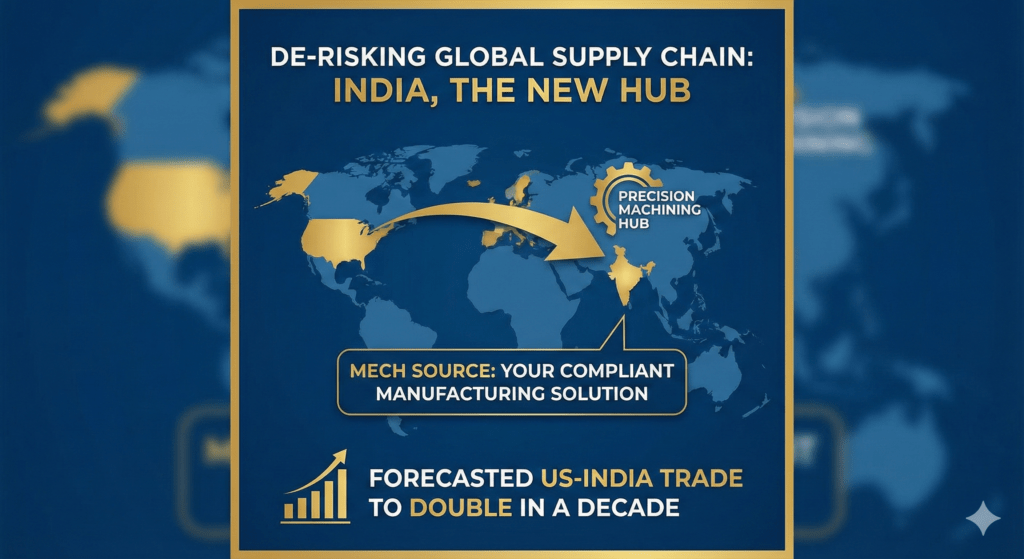
The global environment for original equipment manufacturers (OEMs) has fundamentally shifted. For years, supply chain decisions prioritized unit cost above all else. Today, the focus has pivoted to supply chain resilience, driven by geopolitical volatility and the necessity of risk mitigation. Business leaders are actively seeking comprehensive strategies to navigate these evolving shifts, which are fundamentally reshaping global trade and sourcing partnerships.
For the precision machining sector, this shift has strategically positioned India not merely as an alternative, but as the primary hub for the next decade of high-volume, precision component sourcing.
The Geopolitical Imperative: From Unit Cost to De-Risking
The core driver behind this strategic relocation is the need to diversify supply chains currently concentrated in a single, high-risk region. This movement, often termed the “China+1” strategy, is a direct response to growing trade restrictions and tariff barriers, prompting major US and allied economies to actively seek alternative manufacturing bases.
For Strategic Sourcing Managers, the goal has moved beyond cost optimization to establishing supply base levers that build essential redundancies. Diversifying the supplier base through regionalization and multi-sourcing is the most effective way to mitigate geographical and geopolitical risks. The search is on for partners that can guarantee business continuity and provide robust contingency plans against scalability challenges, single-source dependencies, and lead time disruptions.
The India Advantage: A Foundation for Strategic Growth
India’s ascent as a strategic sourcing hub for precision engineering is supported by a confluence of economic, political, and infrastructural factors:
Macroeconomic Stability and Growth: India represents one of the world’s fastest-growing economies, making it an increasingly attractive expansion target for multinational industrial companies.
Infrastructure Investment: The past five years have seen significant government commitment to capital investment, improving the country’s industrial base through new roads, airports, ports, and rail—all critical for building a competitive manufacturing supply chain.
Geopolitical Alignment: The trend reflects strengthening political and economic ties between the world’s largest democracies. Annual trade between the US and India, for instance, is projected to more than double over the next decade, a testament to the deepening strategic partnership.
Workforce and Incentives: The country provides a huge, low-cost workforce coupled with substantial government incentives designed to encourage foreign direct investment in manufacturing.
The combined effect of these factors positions India as a vital, long-term strategic partner capable of supporting sectors ranging from engineering goods and automotive components to consumer electronics.
Executing Reliability: The Role of the Precision Partner
While the economic and political advantages are clear, successful sourcing from India hinges on selecting the right manufacturing partner—one capable of mitigating the operational challenges that can arise, such as infrastructure bottlenecks or policy complexities. A reliable, long-term partner in the precision machining space must demonstrate specific non-negotiable attributes:
Process Integrity and Quality: The foundation must be a certified Quality Management System, such as ISO 9001:2015, which assures compliance and standardized operational control. For clients, this reduces the need for constant, intensive incoming inspection and diminishes the hidden costs associated with poor quality.
Traceability and Accountability: For critical components, traceability is an absolute necessity. Reputable Indian manufacturers must provide comprehensive material traceability and certification support, ensuring every component can be tracked from raw material origin through final assembly. This is crucial for sectors like automotive and aerospace, where safety and accountability standards are highest.
Ethical Management and Transparency: In an era of heightened Environmental, Social, and Governance (ESG) scrutiny, the supplier must be a socially responsible organization. Core values such as integrity, transparency, and ethical business practices are essential to mitigating reputational risk for the OEM.
By shifting the sourcing conversation from simple component fulfillment to strategic risk mitigation , manufacturers in India that embody high-quality and ethical management practices are securing their role as indispensable partners in the evolving global supply chain. The investment is not just in a geography; it is an investment in long-term resilience, security, and partnership.